
Program Notes
Autumn Organ Concert by Charles Tompkins
The organ music of Johann Sebastian Bach (1685-1750) forms the centerpiece of this instrument’s repertory. Encompassing a dazzling variety of styles and compositional procedures, Bach’s organ works are a musical treasure that never ceases to delight both performers and audiences. This afternoon’s recital, presented in conjunction with Mt. Angel’s annual Oktoberfest, offers a sampling of this wonderful music.
In the printed program and the notes below, each work to be performed includes, in addition to its title, an identifying number preceded by the abbreviation BWV. The latter stands for Bach-Werke-Verzeichnis, a thematic catalogue of Bach’s music compiled by Wolfgang Schmieder in 1950.
Toccata and Fugue in D minor, BWV 565
Our program today opens with Bach’s most famous organ work (and arguably the most famous work in the entire organ literature). Although its title suggests two separate, self contained movements, the Toccata and Fugue in D minor, BWV 565 is actually a single continuous work having three distinct sections of highly contrasting material. It is modeled on the monumental multi-sectional organ works of North German composers active in the generation before Bach and during his lifetime, such as Dietrich Buxtehude (c. 1637-1707); these works carried a number of different titles including Praeludium, Praeambulum, Toccata, and Prelude and Fugue. They alternate sections of dramatic, virtuosic, and quasi improvisatory writing (referred to by eighteenth-century writers as the Stylus Phantasticus) with others in a strict contrapuntal (imitative) style, most often short fugues. The Toccata and Fugue in D minor opens and closes with sections in the Stylus Phantasticus, and has an extended fugue as the second section. The sheer intensity and flamboyance of the Stylus Phantasticus writing, as well as the length and complexity of the fugue, surpass anything seen in the North German repertory. Indeed, the famous opening measures of the work have often been appropriated in modern times for commercial uses, particularly those invoking Halloween!
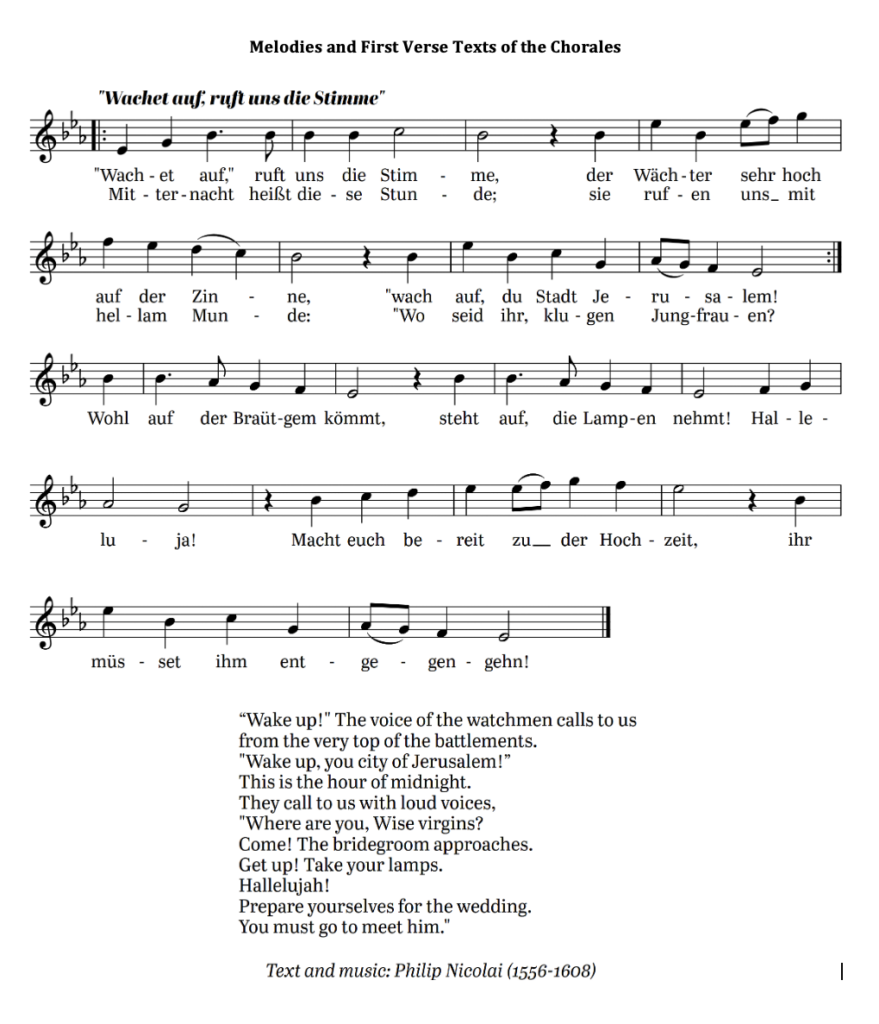
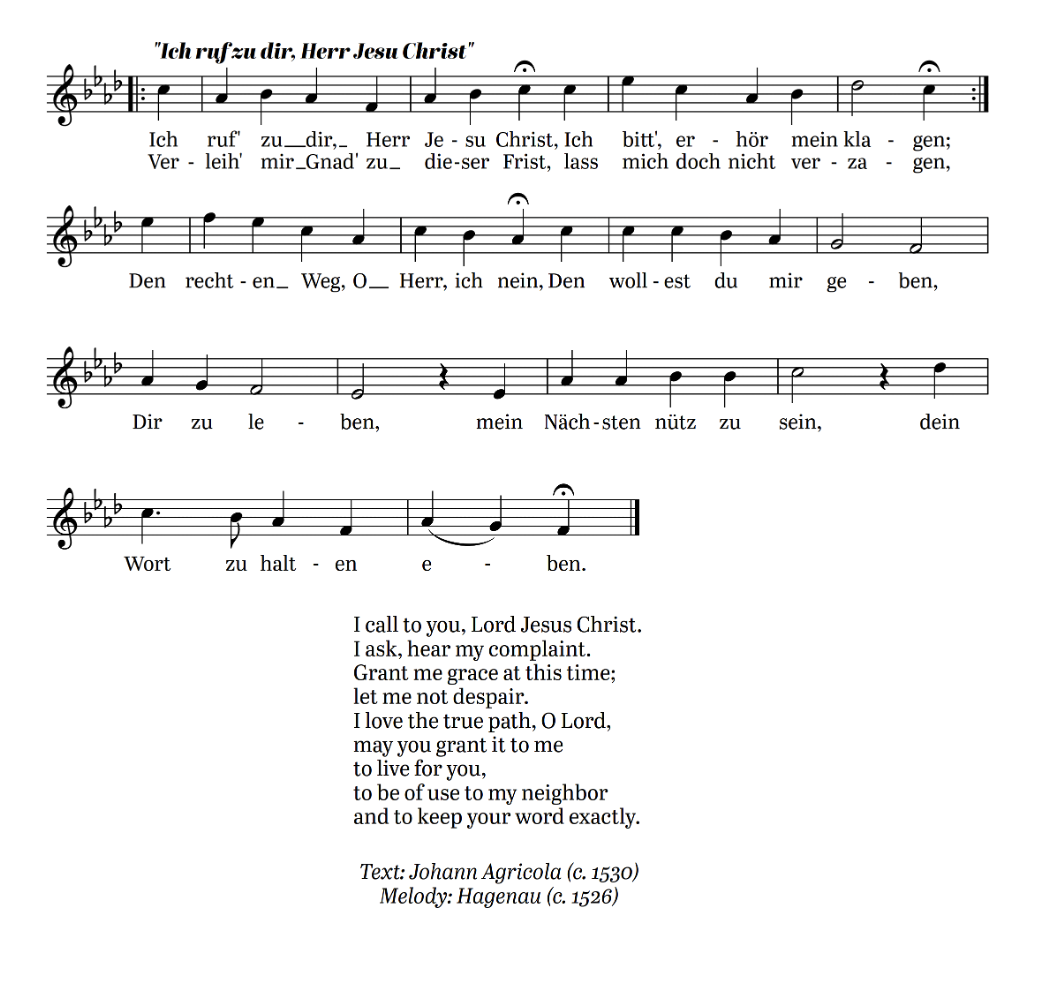
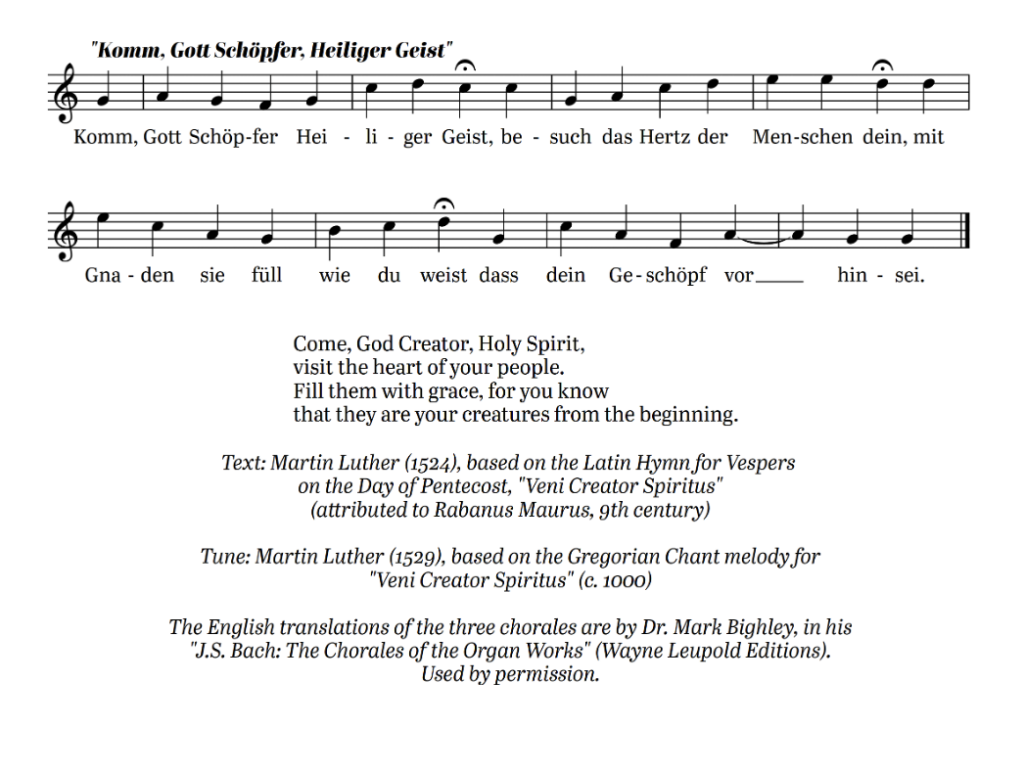
Three Organ Chorales: “Wachet auf, ruft uns die Stimme”; “Ich ruf zu dir, Herr ]esu Christ’’; “Komm, Gott Schöpfer, Heiliger Geist”
An organ chorale is a work for organ that incorporates the melody of a historic Lutheran hymn, or chorale. Chorales were composed from the early sixteenth century, at the beginning of the Lutheran Reformation, through the early eighteenth century; together with the metrical psalms developed in Geneva and England during the same period, they constitute the first substantial body of Protestant congregational song. In more recent times, chorales have become a part of the hymn repertory of the Catholic church as well. Chorales have also been incorporated into organ and choral music, from the sixteenth century to the present day; in particular, their use by Bach – in his sacred vocal works (cantatas, Passions, and oratorios) and organ works – represents a peak of artistic perfection.
“Wachet auf, ruft uns die Stimme” (“Wake, Awake, a Voice is Calling”) is an arrangement for solo organ of the fourth movement of Bach’s sacred vocal cantata of the same name (Cantata 140); this arrangement was made by Bach himself, and is one of six such arrangements that were published in 1745. They are known collectively as the “Schübler Chorales,” after their publisher, Johann Georg Schübler.
“Ich ruf zu dir, Herr ]esu Christ”(“I Call to Thee, Lord Jesus Christ”) comes from a collection bearing the title “Orgelbüchlein” (“Little Organ Book”). The majority of the pieces in this volume are quite short – some just three lines long – and Bach may have intended them to be models for how an organist might introduce a chorale immediately before it was to be sung, i.e. what we today would call a “hymn introduction.” Such short organ chorales are known as chorale preludes. It was expected that chorale preludes would be composed (or improvised) in a musical style that reflected the chorale’s text – either in a general sense (its entirety) or focusing on a specific single verse. (This practice is fundamentally different from the organist introducing a hymn by simply playing a four-part setting from the hymnal, as hymn introductions are often performed today). Thus, chorale preludes encompass a wide range of musical styles, and on occasion may include musical text painting that can be remarkably vivid. Bach’s organ setting of “Ich ruf zu dir” reflects the overall character of the chorale’s text – subdued and intimate – and is cast as a trio: the chorale melody is in the right hand, slightly embellished, with a flowing eighth-note line in the left hand, and cello-like repeated notes in the pedal.
“Komm, Gott Schöpfer, Heiliger Geist” (“Come, Creator God, Holy Spirit”) is part of a collection of organ chorales known as the “Leipzig Eighteen” or “Great Eighteen.” The majority of these works were composed during the period when Bach worked at the Court of Weimar (1708-1717), and they were later revised by him during his years in Leipzig (1723-1750). The melody of “Komm, Gott Schöpfer, Heiliger Geist” – which is based on the Gregorian Chant hymn for Vespers on Pentecost Sunday, Veni Creator Spiritus – is presented here in two sections. The first, a mere eight measures in length, borrows (note for note) the setting of this chorale found in the Orgelbüchlein; vivacious and dance-like, in 12/8 meter, its use in BWV 667 represents a kind of “musical recycling” on Bach’s part. The borrowed Orgelbüchlein music then leads seamlessly into a newly composed, contrasting second section, where the chorale melody is heard in long note values in the pedal.
At the conclusion of these program notes, you will find the melodies and first verse texts of the three chorales these organ pieces are based on.
Prelude and Fugue in G major, BWV 541
One of the most vivacious and joyful of Bach’s organ works, this Prelude and Fugue (as well as the Passacaglia and Fugue in C minor, which opens the second half of today’s program) were composed during Bach’s years in Weimar, where the majority of his organ works were written. The Prelude features three principal elements, heard in succession at the start of the piece: an extended passage of rapid scalewise and arpeggiated writing for the hands; a majestic motive played in the pedal, at its first entrance; and a series of repeated chords in the manuals. The Fugue is based on an extended subject (or principal melody), one that contains numerous repeated notes and generates a perpetual motion texture.
Passacaglia and Fugue in C minor, BWV 582
This technically and musically monumental work is based on an eight-measure theme, heard in the pedals alone at the outset of the piece. The first eight notes of this theme come from a “Trio en Passaçaille” by the French composer André Raison (1650-1719), found in his Messe du Huitième Ton (a work Bach copied by hand). Bach extended the melody, adding an additional four measures that lead to a conclusive cadence:
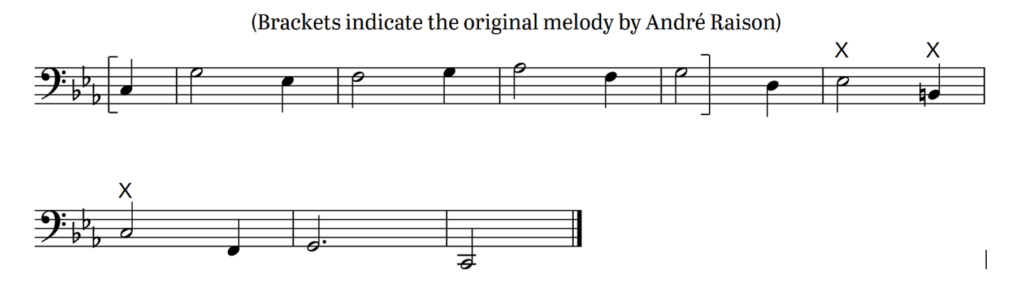
Bach uses this melody as the basis for a series of twenty-one continuous variations encompassing a wide variety of textures and figurations. It is heard most often in the pedals, in its original form, but it also migrates into the hands at various places, where it is at times embedded within different types of keyboard figuration (such as scales or arpeggios) or motivic ideas. The final variation is an extended fugue with two countersubjects, the first of which is based on three pitches (marked with x in the melody shown above) from the second half of the Passacaglia theme .
“Jesu, Joy of Man’s Desiring”
“Jesu, Joy of Man’s Desiring” is one of Bach’s most famous and beloved works: a beautiful, lyrical arrangement of a chorale melody by Johann Schop (c. 1590-1667), Werde munter, meine Gemüte, set for four-part choir with an iconic accompaniment played by a small instrumental ensemble. It is found in Bach’s Cantata 147, Herz und Mund und Tat und Leben (Heart and Mouth and Deeds and Life), where it appears twice, in the sixth and tenth movements. The music is identical in the two movements, but their texts are different; they are drawn from a 1661 chorale, Jesu, meine Seelen Wonne (“Jesus, My Soul’s Delight”) by Martin Janus (c. 1620-c. 1662). Verse 6 of that chorale, “Wohl mir, dass ich Jesum habe” (“It is Well with Me That I Have Jesus”) is used in Cantata 147’s sixth movement, and verse 16, “Jesus bleibet meine Freude” (“Jesus Remains My Joy”) appears in the cantata’s tenth movement.
“Jesu, Joy of Man’s Desiring” is a translation of Jesu, meine Seelen Wonne by the twentieth-century English poet Robert Bridges. It was first used as a title for the music of Cantata 147’s sixth and tenth movements by the English concert pianist Dame Myra Hess (1890-1965), in her 1926 arrangement of that music for solo piano. The great popularity of Dame Hess’s arrangement led to “Jesu, Joy” becoming the standard title found in publications of this music in England and America.
Like the fourth movement of Cantata 140, heard earlier on today’s program in an arrangement for solo organ by Bach himself (Wachet auf, ruft uns die Stimme), “Jesu, Joy of Man’s Desiring” has also been frequently arranged for organ, beginning in the early twentieth century. The arrangement heard today is by the great concert organist E. Power Biggs (1909-1977).
Toccata in F major, BWV 540
The exuberant and virtuosic Toccata in F major, BWV 540 is one of Bach’s greatest free (non-chorale based) organ works. It begins with canonic (strictly imitative) passagework in the hands, played over a long-held note in the bass, or pedal point; this is followed by an extended solo for the pedals. These two elements are then repeated – transposed to the key of C major – which then leads to a striking harmonic sequence using arpeggiated (broken) chords in the hands. The remainder of the Toccata alternates repetitions of this harmonic sequence with contrasting three-part (trio) writing. The final pages of the work include some of the most magnificent writing in all of Bach’s organ music, including a passage where the music literally traverses the entire range of the keyboards: first, from the top to the bottom, and then returning to the top. A final emphatic series of sequences brings the Toccata to an exhilarating conclusion.
Melodies and First Verse Texts of the Chorales
About the Artist
CHARLES TOMPKINS is Distinguished University Organist and Professor of Music Emeritus at Furman University, Greenville, South Carolina, where he taught organ, harpsichord, church music, and music theory from 1986 until his retirement from the teaching faculty in December, 2022. In 2023 he transitioned to a new position as Distinguished University Organist, in which he continues to serve as organ accompanist for the University’s outstanding choral ensembles (the Furman Singers, Furman Chamber Choir, and Belle Voci (Women’s Chorale)), and as Director of Furman’s Hartness Organ Recital Series. He also plays for academic convocations, and for weddings and other services in the Charles E. Daniel Memorial Chapel, including the annual Festival of Lessons and Carols in December and the Palm and Passion (Palm Sunday) service each spring. The chapel is home to a three-manual, 42-stop C.B. Fisk tracker action organ (2004), for which Dr. Tompkins developed the specification (stoplist) and oversaw the installation.
An acclaimed performer, Dr. Tompkins has presented recitals at major universities and churches throughout the United States, often in conjunction with masterclasses and lectures. Highlights of his performing career in the United States have included recitals at the John F. Kennedy Center for the Performing Arts in Washington, DC, the Piccolo Spoleto Festival in Charleston, SC, and for national and regional conventions of the American Guild of Organists, Association of Anglican Musicians, Music Teachers National Association, and College Music Society. He has performed abroad in Germany, Italy, Switzerland, France, and England, including recitals at the Cathedral of Notre Dame, Paris; St. Paul’s Cathedral, London; and the Chapel of King’s College, Cambridge. His recitals have been featured on American Public Media’s nationally syndicated Pipedreams radio and online program.
Active as a church musician throughout his career, Dr. Tompkins currently serves two historic Greenville congregations. As Organist of First Baptist Church, Greenville, he presides over one of the largest pipe organs in the state of South Carolina, an 86-rank, four-manual instrument by Casavant Freres Ltée.; and as Artist in Residence for Christ Church (Episcopal), Greenville, he plays both an 80-stop Cornell Zimmer/Walker Technical digital organ and a 65-rank Goulding and Wood pipe organ.
Professor Tompkins holds the degrees Doctor of Musical Arts and Bachelor of Music from the Eastman School of Music, which awarded him its Performer’s Certificate in recognition of outstanding performing accomplishment, and the Master of Music degree from the University of Michigan. His principal teachers were Russell Sanders and Robert Glasgow (organ) and Lenora McCroskey (harpsichord).